In the Official Competition of the 76th Berlinale, Flies, the new film by Fernando Eimbcke, was screened. The Mexican director, who debuted with Duck Season at Cannes, won the Alfred Bauer Prize and the FIPRESCI Award in Berlin with Lake Tahoe, took the Golden Shell in San Sebastián with Club Sandwich, and returned to the festival in 2025 with Olmo. His cinema has always been marked by expressive economy, a dry gaze, and exceptional work with young actors. Moscas confirms that coherence while moving into darker—yet ultimately hopeful—territory.
Moscas, Dark and Hopeful
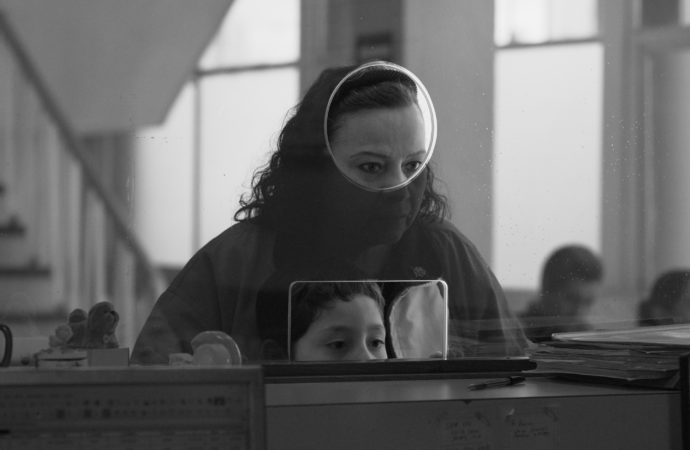
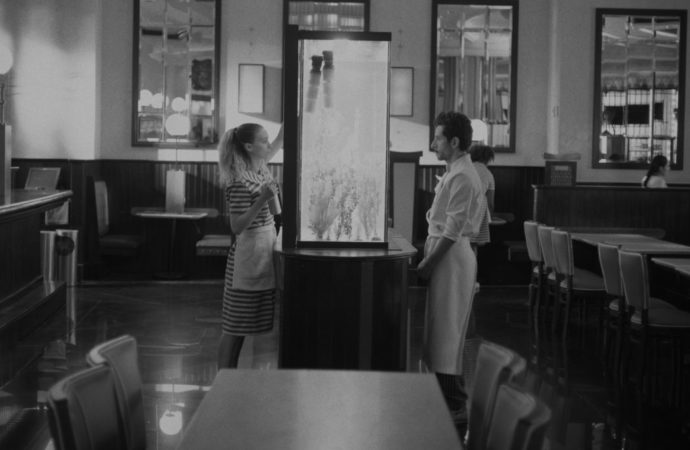
Shot in austere black and white, the film unfolds almost entirely within a vast apartment block opposite a hospital. Olga (Teresita Sánchez, awarded at Sundance for Dos Estaciones and memorable in The Chambermaid and Tótem) lives alone, clinging to a strict routine, without friends or relationships. Her world is measured, controlled, silent. Out of financial necessity, she is forced to rent out a room. The tenant, Tulio (Hugo Ramírez), does not arrive alone: he secretly brings his nine-year-old son, Cristian (Bastian Escobar), into the apartment.
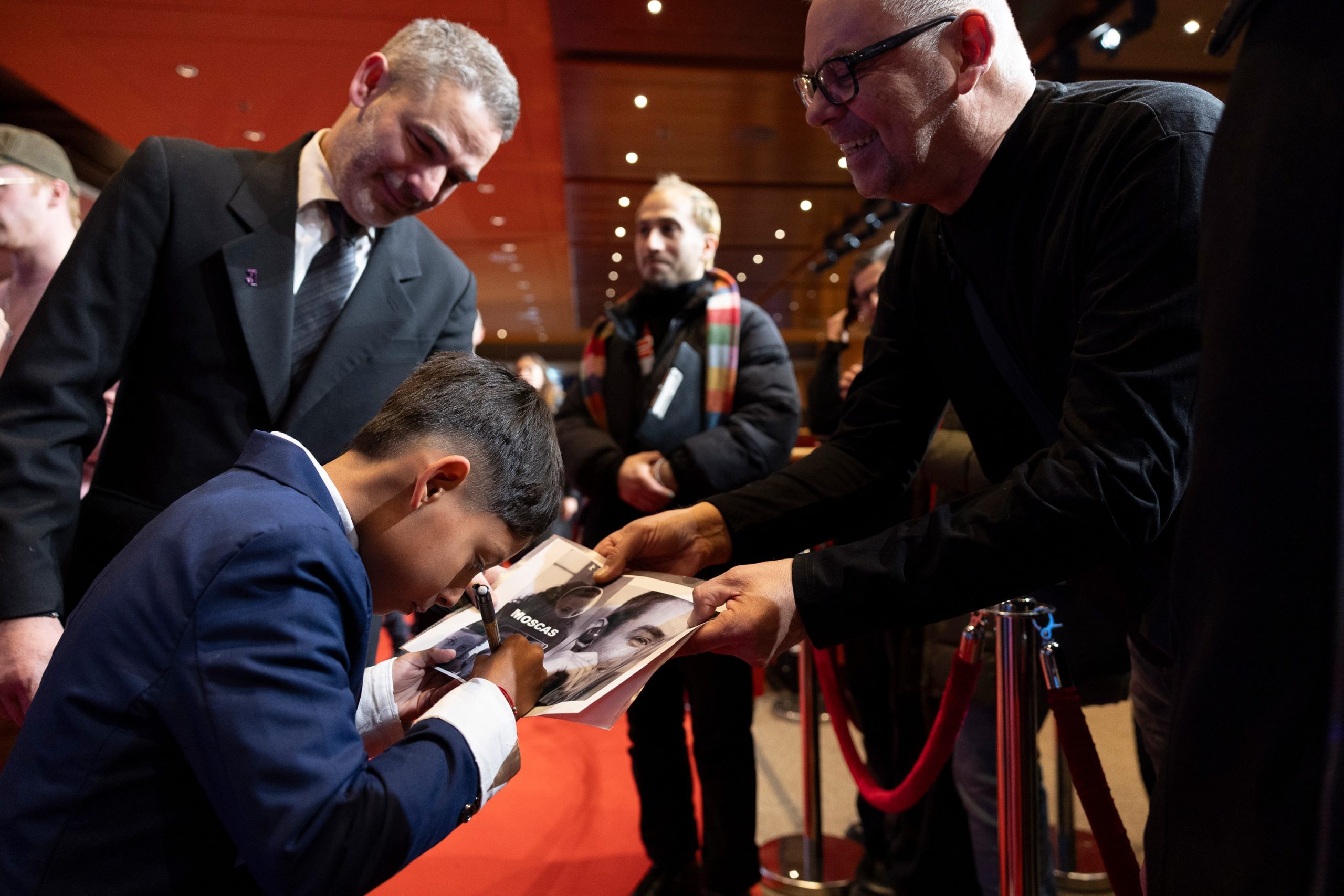
Bastian Escobar and Fernando Eimbcke in the Berlinale Palast.
What might have been a conventional social drama becomes instead in Flies a meticulous study of solitude and grief. Young Escobar, a debutant with remarkable natural talent, embodies the boy with disarming freshness. At times curious, at others stubborn or mischievous, he navigates a world whose rules he does not fully understand, guided by instinct. His eyes are strikingly expressive before the camera and, rather than retreating into himself, he delivers outstanding two-handers with Sánchez.
She, for her part, shapes an Olga hardened by emotion yet at the same time fragile, as if that lightness—contrasting with the heaviness of her movements—were a treasure overshadowed by pain, inevitably surfacing in acts of care. Olga and Cristian form a compassionate, generous partnership, and the director gradually helps us blur the gap that separates them, allowing us to witness how both are transformed.
An Uncomfortable Transformation
The screenplay by Vanesa Garnica and the director himself avoids sentimentality. The socioeconomic reality—that sea of people living side by side without ever truly touching—is present, but not as a manifesto; rather, as atmosphere. Olga’s transformation in Flies is neither spectacular nor redemptive; it is gradual, uneasy, almost imperceptible.
The video game Cosmic Defenders, located outside a convenience store, functions as a highly effective metaphorical and atmospheric device. Its electronic pulses—almost the only incidental music in the film—accompany Cristian’s emotional state and become a space for processing grief. Within that exchange of repetitive lights and mechanical sounds, a nearly magical intersection occurs between childhood and adulthood: the boy copes with absence through play; the woman learns to watch him and, unknowingly, to look at herself.
Sobriety and Rigor
Produced, among others, by Michel Franco, Flies maintains the sobriety and rigor that have defined its director’s filmography. The black and white is not a gratuitous aesthetic gesture, but a deliberate choice that strips the environment of distractions and focuses attention on bodies, gazes, and silences.
At a festival where we have seen an excess of emphasis and fireworks, Moscas opts for minimalism. Three characters, an apartment, a corridor, a luminous screen. And yet, within that restraint lies its strength. The film demonstrates that even in a setting of extreme isolation, an unexpected bond can open a crack in the carefully constructed order of solitude.
No one has posted any comments yet. Be the first person!
Estamos utilizando cookies para darle la mejor experiencia en nuestro sitio web. Puede encontrar más información sobre qué cookies estamos utilizando o desactivarlas en configuración.




No one has posted any comments yet. Be the first person!