
Some performances do not assert themselves through immediate impact, but through a deeper, almost silent form of authority. Giuseppe Verdi’s Macbeth, presented at the Teatro Regio in Turin, was one of those: a reading that did not seek to dazzle through noise, but to win from within, shaping the sonic material as if it were a pictorial chiaroscuro. In the pit stood none other than Riccardo Muti, undoubtedly the greatest Verdian conductor of our time, who offered an interpretation refined to its very essence—the result of a long and thoughtful relationship with the score, in which every dynamic indication seemed considered and reconsidered until it acquired its own eloquence.
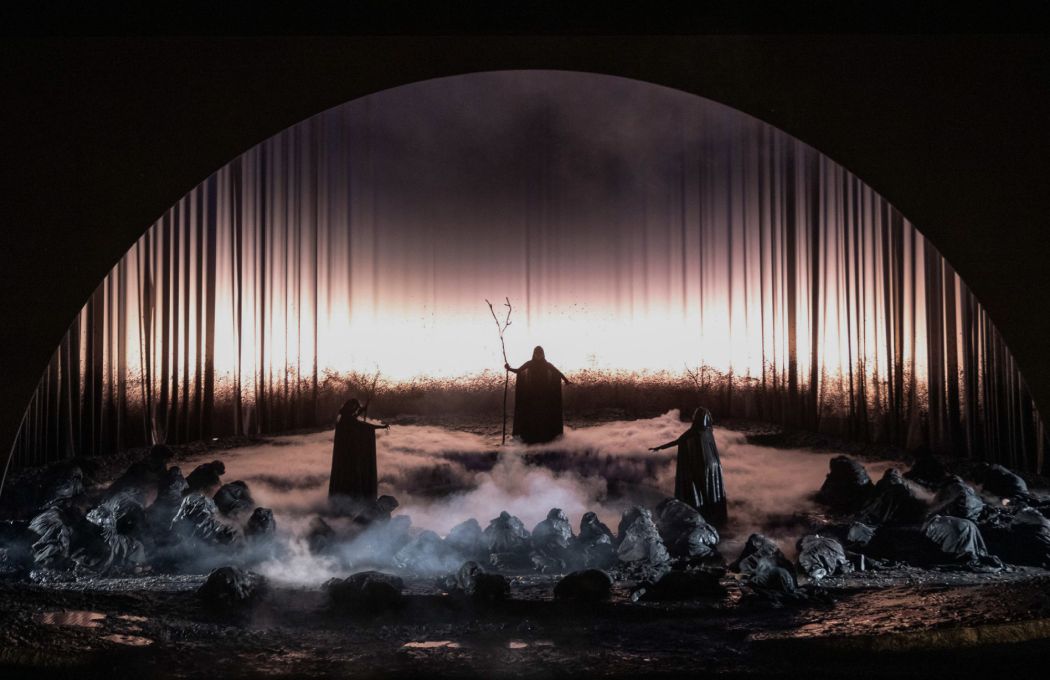
The opening scene of Macbeth in the Teatro Regio di Torino production. © Daniele Ratti.
Perhaps the most admirable aspect of this latest approach was the command of dynamics and, above all, of silence. Not silence as a mechanical pause, but as dramatic tension. The pianissimi—threaded to the very edge of audibility—were not precious effects, but zones of shadow where the drama could breathe, and the key moments were shaped with almost artisanal patience, avoiding premature outbursts and easy emotion. Within this conception, the Orchestra of the Teatro Regio responded with an extraordinarily nuanced palette of colours: strings whispering with barely contained unease, woodwinds emerging like omens, and low registers opening genuine abysses. The overall impression was that of witnessing an inner tragedy, where violence is conceived in the conscience long before it manifests itself in action.

Lidia Fridman in Act I of Macbeth. © Mattia Gaido.
The great collective moments—the true dramatic pillars of the score—were without doubt the most moving. Muti avoided any declamatory excess and shaped the layering of musical planes with almost architectural clarity. The voices did not dissolve into the orchestral mass; instead, they retained their contour, integrated into a compact yet transparent texture. Under this approach, “Patria oppressa” reached a restrained and noble intensity, free of sentimentality, sustained by exquisite control of tempo and by silences that seemed to prolong the pain beyond the final note.
The famous sleepwalking scene offered another example of this theatre of detail: a lightened orchestra, suspended breathing, and a tension carried less by outward gesture than by what remained unspoken. Even the light witches’ chorus that closes the apparition scene in the third act—often treated somewhat superficially—acquired a spectral, yet subtly ironic quality, thanks to the extreme lightness of the sound and the rhythmic precision imposed from the podium.

Maharram Huseynov in Act II of Macbeth. © Mattia Gaido.
The cast assembled by the Neapolitan maestro responded with professionalism and commitment to the conductor’s conception, though with uneven results. Luca Micheletti offered a Macbeth of notable stage presence. An experienced actor as well as a singer, he shaped from the outset a nervous, tormented character of sombre elegance. His carefully coloured timbre adapts intelligently to half-voice and whispered inflection—qualities that fitted well within the overall aesthetic of the performance.
Even more striking was the impact of Lidia Fridman as Lady Macbeth. Here one sensed a true embodiment of Verdi’s ideal: a voice capable of sounding harsh and shadowed without losing support or sheen, with firm low notes and high notes that emerged with authority. From her entrance aria the Russian soprano made clear both her technical and expressive command; in “La luce langue” she negotiated the difficulties with assurance and character, while the brindisi displayed flexibility and rhythmic control. Yet it was in the sleepwalking scene that she reached the summit of the evening: intensely nuanced phrasing, finely regulated dynamics, and an expressive use of filato that turned each word into a fragment of a shattered conscience. At present, she stands as a compelling reference for this role.

Apparition scene in the third act of Macbeth. © Daniele Ratti.
Maharram Huseynov offered a Banquo of dark accent and homogeneous timbre, well suited to the sombre tone of the production. His line was noble, and his vocal presence conveyed the character’s dignified sorrow. Giovanni Sala, as Macduff, stood out particularly in his aria in the fourth act, preceded by a recitative delivered with intensity and a sober, sincere sadness; his singing, well supported and clearly projected, provided a moment of genuine emotion within the overall atmosphere of restraint.

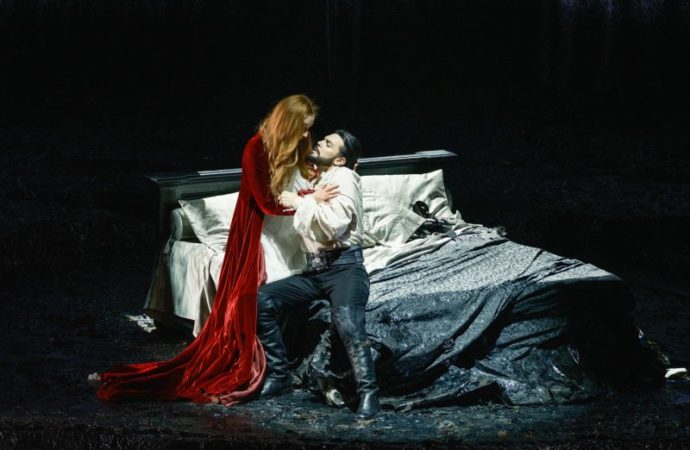
Luca Michetti y Lidia Fridman in the end of Act II of Macbeth. © Mattia Gaido.
The staging by Chiara Muti decisively placed the core of the opera within the night, understood not merely as atmosphere but as a mental territory where the supernatural takes root. It was a choice far from obvious today, and precisely for that reason effective: a stylistically plural Macbeth in which realism, choreographic symbols, flashes of surrealism and an evocation of Elizabethan theatre coexisted, leaving ample room for the spectator’s imagination while never losing sight of the dramaturgy inscribed in Verdi’s score.
Within this framework, the set design by Alessandro Camera, the costumes by Ursula Patzak, and the lighting by Vincent Longuemare created a visual universe of rare suggestiveness—dark, unsettling, like a lost territory of the unconscious. Together they formed a coherent synthesis, deeply faithful to Shakespearean truth, bringing Verdi—naturally and without strain—closer to the playwright who most profoundly shaped his theatrical imagination.

Luca Michetti in the end of Act II of Macbeth. © Mattia Gaido.
The overall result was a performance of remarkable artistic coherence and a level rarely encountered in these days of productions driven more by effect than by substance. Rather than offering a Macbeth of immediate impact, the evening revealed a reading of great artistic maturity, in which the force lay not in volume but in the intensity of the phrasing and the density of silence. It was one of those nights when the theatre reminds us that true greatness does not always need to shout: sometimes it is enough for it to whisper—provided it speaks the truth.

No one has posted any comments yet. Be the first person!