

Frontier (Frontera, 2025) marks a turning point in the career of director Judith Colell. With a more ambitious budget and a clear intention of reaching a wider audience, the filmmaker — who is also president of the Catalan Film Academy — ventures into a historical thriller set in 1943 in the Pallars region of Lleida, near the French border. Between 1943 and 1945, more than 80,000 people crossed the Pyrenees clandestinely to escape Nazism, an episode rarely explored in Spanish cinema and one that here becomes central to the film’s dramatic weight.
The story follows customs administrator Manel Grau (Miki Esparbé) and his wife Mercè (María Rodríguez Soto), former Republican activists whose quiet and safe retreat is disrupted by their growing political and humanitarian awareness. Figures such as the mayor, Ovidi (Jordi Sánchez) and José Antonio Sánchez, the Civil Guard officer played by Asier Etxeandia, embody the complex loyalties of a region marked by fear and uncertainty. In an apparently idyllic and isolated place, the threat of the Holocaust converges with the triumph of totalitarianism in post-war Spain, where the maquis still persist in their organised rebellion from the shadows, acting as a human bridge for other persecuted individuals. In Frontier, the couple formed by Juliana (Bruna Cusí) and Jérôme (Kevin Janssens) represents, meanwhile, an incorruptible resistance — a pillar of humanity without borders.
After its premiere at the 70th edition of SEMINCI, Frontier has been selected for the programme In Focus Catalonia, of the 29th PÖFF, the Tallinn Black Nights International Film Festival, which this year pays an extensive tribute to Catalan cinema — one of the most prominent and award-winning film industries on the international circuit in recent years. Following its screening the previous night, Judith Colell joins us for this interview as darkness begins to deepen the greys of this welcoming Baltic city on the threshold of winter.
A New Stage
We begin the interview, curious about this new direction in her work as a director: “This film was an assignment. The producer, Marta Ramírez from Coming Soon, called me to offer me the project. When I read it, I discovered it was a period film, with a large budget and many characters. And I said, ‘Are you sure?’ She replied yes, that I would do it very well, so I decided to try. We worked extensively on all the artistic decisions, the casting; we changed the script, although the project itself came from the production company and the screenplay had already been written by Miguel Ibáñez Monroy and Gerard Giménez Forner.”
After watching the film and witnessing the audience’s reaction — especially their very active participation in the post-screening discussion — it’s clear that the professional advice Colell has received lately about the need to “open up” her cinema has proven accurate: “People told me I needed to make a film that could connect, that my authorial gaze is great, but it should also reach the audience. In this project, I saw that opportunity.”
Relevant Women
This kind of film is not usually offered to female directors, and that was an aspect that drew her to the project: “This is very interesting for women in the profession, because we usually work with small budgets, so having access to a certain level of funding — a film with thriller and action elements that we can make ourselves — is important.”
As for the female characters, the women in Frontier are driving forces in the narrative; they make decisive choices and show a sense of solidarity with one another, all expressed with naturalness and credibility. Colell, who co-founded the professional association of women filmmakers CIMA, confirms this: “It must be something truly intuitive rather than conscious, because I only realised it after the film was finished, when talking with María Rodríguez Soto. It’s true that the women are given weight in the decision-making; they determine the direction the characters take, but as I say, it was completely intuitive. The screenplay is written by two men, of course, but two men who clearly placed those characters there. Meaning, those characters already existed. Juliana, Mercè — all these characters are there, and they have strength on their own. People say this is the screenwriters’ work, and I was very involved in the script in the final stage, but in terms of staging, I do believe it was an intuitive choice to give women that prominence.”

The staging decisions are very clear in this regard: “For example, in the dinner scene at the Nazi officer’s house, where the men [the village mayor, the customs administrator, and the German] are talking about very important matters in the background, out of focus—what do we pay attention to? Mercè’s attitude. Because what interested me about that dinner was the behaviour of the three women: the mayor’s wife, who is there almost as if she weren’t; the Nazi’s wife, who is practically more wicked than her husband; and Mercè, who later takes control and, once back home, says, ‘Don’t ever do this to me again.’ She is a woman with left-wing ideals who lost the war, who lives defeated, carrying her ghosts and the weight of guilt.”
An Acting Dream Team
The characters in Frontier are constructed with enough complexity for us to believe in them and care about them. The two male protagonists, Sánchez and Manel, reveal — beyond what their dialogue supports — the emotional burdens they are carrying at that moment in their lives, and this is not just the merit of the script. The director expresses her boundless admiration for her actors’ talent: “The truth is, I have very good actors — the Dream Team of Catalan cinema, and of course Asier. They are also very intelligent actors who question everything. We rehearsed for several weeks, discussing every line of the script, every trait of the characters. As Ingmar Bergman said, ‘I’m not a good director of actors; I’m a good director of casting.’ And I always tell my students at the university: don’t just look for good actors, look for committed people who question what they do. A good actor is not enough if — and I’ve had a few — they say, ‘You’re the director, tell me what to do and I’ll do it.’ For me at least, as a director, that’s not enough if they don’t challenge me: ‘Why this? Where are we going with this? And this character — why does he behave this way in this situation?’”
The actress Pepa López appears in the film in a small but highly significant role, to which she brings her talent and elevates one of the scenes in an impressive way — with a restrained emotional intensity that tightens the throat without needing a single word. “I was very lucky to have her in the film. She is also incredibly easy to work with. She’s someone who questions things from a positive place, and she’s a wonderful actress. The truth is, she conveys everything with her eyes.”
This is not the only scene in Frontier where gesture tells the story: “Yes, in that scene between Judit, the Jewish maid (Anna Franziska Jäger), and Mercè, we see her smile for a moment — and that alone tells you everything.”

The Drama of the Mountains
The film’s production design does not romanticize the landscape; the Pyrenees appear as a world apart, where the characters are suddenly engulfed by the consequences of a world war. “Here, once again and as always, it’s the team. We are orchestra conductors. In this case, Marta Bazaco is a great production designer (El 47), extremely meticulous. For example, she knew exactly what people in the Pyrenees would eat for dinner when they were sick or when it was cold. I also had the essential collaboration of costume designer Mercè Palomas (Pa negre); her work was very important. We had a large warehouse where the clothing was aged and its colours treated… as if a war had passed through it. The cinematographer was Andreu Adam Rubiralta, one of the key pillars of the film.”
Regarding how the landscape is portrayed, Judith Colell reveals that she approached the mountain as a character that creates a sense of fear, claustrophobia, and abandonment. “In the Pyrenees they were isolated; misery was not like in the big cities. They lived in a kind of small bubble within themselves. And the mountains have this claustrophobic quality — the fear of not knowing what’s out there. I remember being on a location scout and hearing the deer in mating season — they make an enormous noise — or noticing a movement among the trees and thinking, ‘What is that?’ There is a sense of threat in the mountains that worked very well for the film.”
And of course, there is also the beauty of the landscape. “I felt that had to be present. The original story was inspired by real events and took place in the Aran Valley, which is also a special place because it’s a valley surrounded by mountains and very isolated. But the Aran Valley is now highly modernised, whereas Pallars Sobirà — which I believe is one of the most beautiful places in Europe — still has something wild about it, even in its people. I thought that was very interesting because it frames the story almost like a western. They are living there in subsistence and relative calm — because they’ve just come out of a war — and then someone from the outside arrives and triggers the fear of the stranger. All of this, which speaks directly to the present, seemed very compelling to me. Because, of course, I’ve always made social cinema, and suddenly I was moving into making a historical film. But by talking about the past, we understand the present.”

In Frontier, we hear the characters speak Spanish, French, German and Catalan in two different dialects: “Multilingualism is very important in my film. On the one hand, it reflects the difference between the forces of the State, who speak Spanish, and on the other, the local dialect of the area. I researched and found out that there were local Civil Guards, young men, who spoke in their dialect, even if it sounded unusual, and I insisted that the villagers speak in their local variety, which is not widely used today, but that they speak it as it was spoken in the 1940s. We had a wonderful actor from Tremp as our dialect coach, who helped us with pallarès. In fact, sometimes it’s difficult to understand for a speaker of central Catalan.”
The Referential Universe of Frontier
Judith Colell had a whole aesthetic and historical universe in mind while shaping her film; her references were multiple and not only cinematic: “I always keep Lucian Freud’s work present, and for this film I also worked extensively with artists who portrayed refugees during the World Wars, such as Käthe Kollwitz. I also used photographs from the period, but my visual references included Son of Saul, for instance, which was very important to me. I think it is one of the best films about this period of history, with its treatment of the close-up. In Frontier I combine this extreme close-up — which is quite common in my films — with those super wide shots that I use here for the first time, because we had the mountains, and the way to mark their presence was with these frames that place the characters small against that immensity. That, indeed, is something new.”
Regarding the character work, Colell kept The Spirit of the Beehive (Víctor Erice, 1973) very much in mind. “I told Miki Esparbé to study Fernando Fernán Gómez’s character closely, because that sadness, that weight carried by the defeated, was exactly what interested me for them. Walter Benjamin was also a reference, of course. And then a curious one appeared as we moved toward the western tone: The Power of the Dog, a wonderful film. Another reference I later discovered was A Hidden Life by Terrence Malick, which is set during the Second World War in a high-mountain village.”

History to Understand the Present
When we ask Colell about her contribution to the subgenre, she does not hesitate to point out that this historical period is never discussed enough, and that—contrary to common belief—there are not actually that many films that address the Civil War and the post-war in all their dimensions. Among the most recent ones, the director highlights what she considers a hidden gem: “La buena letra, by Celia Rico, is a wonderful film that deserves to be seen far more widely. Why do films go unnoticed when they are true jewels? Celia’s film is one of them; watching it, I can’t help but feel the story isn’t over yet. We still have so many stories from our past to tell… It’s not about war, it’s about history. And as long as we have 70% or 80% of young people who believe that life under Franco was better or much better, it means we still need to keep examining our past, because it seems we’ve forgotten.”
Acts of remembrance are necessary — not only ours, but Europe’s and the world’s — if we want to understand the present. “And this film speaks about people who need to flee their countries, like in that poem by the Anglo-Somali poet Warsan Shire: ‘You have to understand that no one puts their child in a boat unless the water is safer than the land.’ It’s the same here: no one sets out to cross mountains unless the place they are leaving is more dangerous. No one wants to leave their home. With this film we wanted to contribute, even if only a grain of sand, to honour those who help — and those who, at a certain moment, were looking the other way, until something made them realise they could no longer stand by with their arms crossed.”

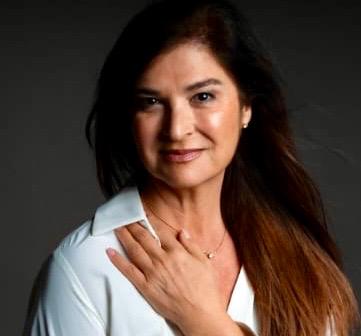
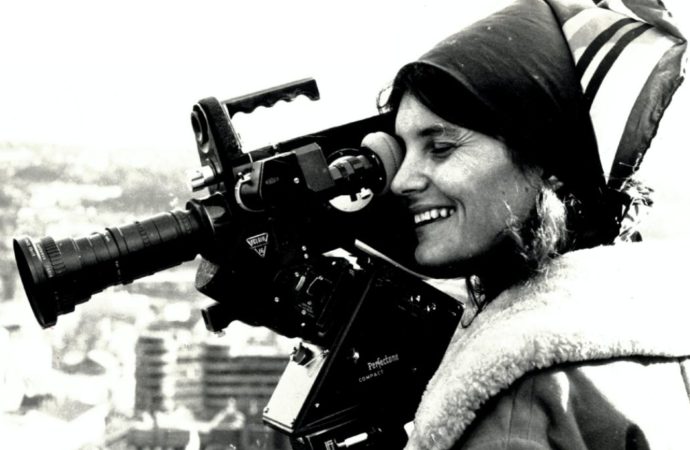
Judith Colell. Photo: Mia Tohver (29 PÖFF).
Frontier shows us that one never stops being an auteur, and that generous budgets, star-studded casts and period productions can also serve as a canvas on which a filmmaker leaves her own mark. We say goodbye to Judith Colell as she tells us about her next project, centred on the Republican schoolteachers of the 1940s — the founders of progressive, free education — a tribute to the roots of today’s educational system and to its great pioneers.
Frontera will be released in cinemas in Spain on December 12.
No one has posted any comments yet. Be the first person!