
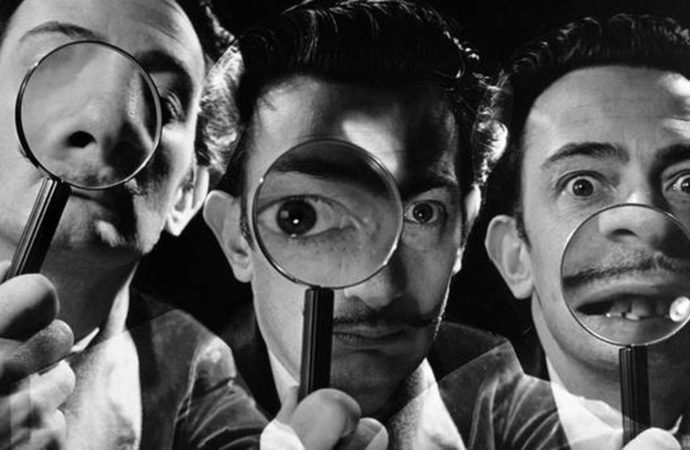
There must have been something extraordinary about Philippe Halsman (Riga, Latvia, 1906 – New York, 1979), an innovative and ironic pioneer of 20th-century artistic photography, to persuade hundreds of the figures who shaped the century to pose before his camera: politicians, actors, film directors, athletes, writers, and aristocrats. An endless list of names whom he portrayed in the most original ways, constantly exploring new uses of the camera and its possibilities to capture the essence of his subjects.
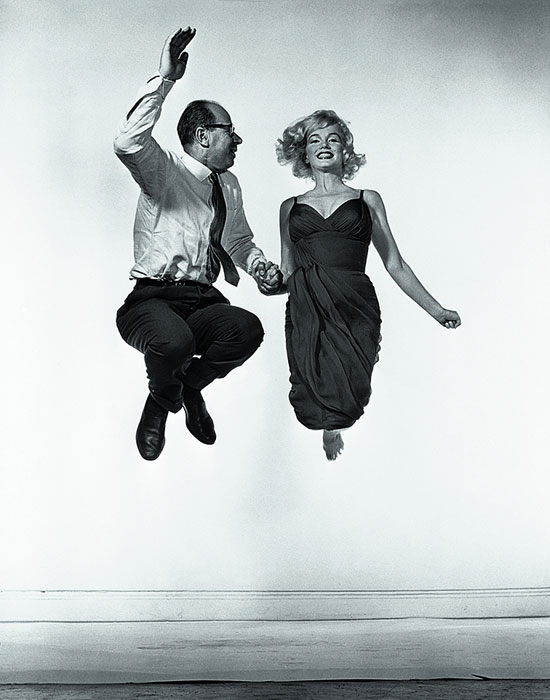
Marilyn Monroe Jumping with Philippe Halsman (Yvonne Halsman, 1954).
This is the case with his jumpology series, in which he literally made his subjects jump, as Marilyn Monroe did at two different moments in her life: at the beginning of her acting career and years later, when she had already become one of Hollywood’s most sought-after stars.
For Halsman, the act of jumping helped strip away the subject’s mask in front of the camera; more focused on the physical act than on their expression, they revealed a more spontaneous, relaxed, and playful side than in conventional portraiture.
Monroe had her first cover on LIFE magazine in 1952 with one of these jumps—a publication for which Halsman would go on to produce 101 covers. Years later, in 1959, already at the height of her stardom, she was invited back for another jumping session. However, having by then discovered—much to her dismay—that Halsman’s method aimed precisely to reveal her true personality, it took 200 jumps and three hours before the photographer captured the image he was looking for.
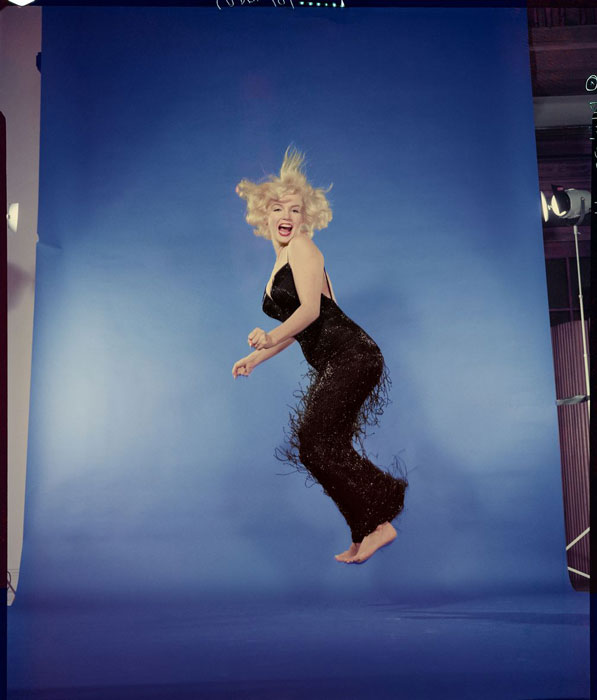
Marilyn Monroe, 1959.
In 1959, the book Philippe Halsman’s Jump Book was published, capturing 170 celebrities mid-leap in uninhibited motion, including Dean Martin, Grace Kelly, Gina Lollobrigida, Jerry Lewis, Shirley MacLaine, Jacques Tati, Fred Astaire, the Dukes of Windsor, and even Richard Nixon himself.
His relationship with Salvador Dalí began in a New York gallery in 1941 and lasted for nearly forty years. It proved decisive for his career, as this artistic partnership enabled him to pursue unique ideas and experiments inspired by the personality and work of the painter from Cadaqués. More than five hundred photographs make up the archive of images Halsman created of Dalí, including iconic works such as Dalí Atomicus (1948), in which water and cats are thrown into the air.
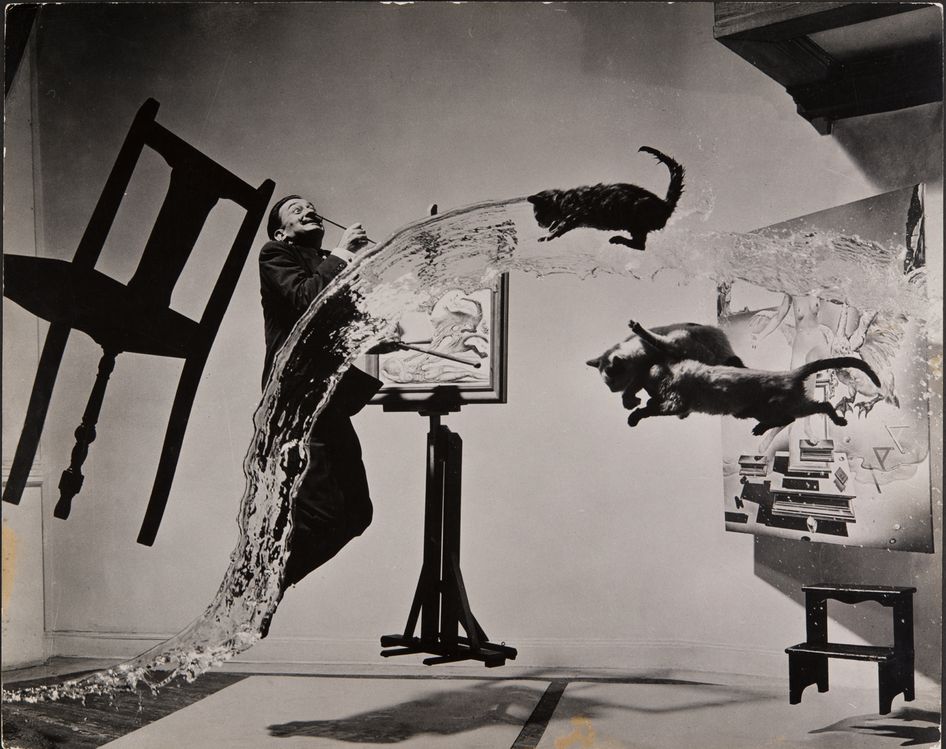
Dali Atomicus, 1948.
In 1954, the book Dalí’s Moustache was published, the result of two years dedicated to photographing the painter’s moustache.
In the field of dance, the Latvian photographer produced iconic images of figures such as Martha Graham, Merce Cunningham, and Alicia Alonso. In one striking photograph, Cunningham appears suspended in mid-air while Graham watches impassively from a nearby armchair.
His career was remarkably prolific. It began in 1930s Paris, where he definitively abandoned his training as an engineer after being granted political asylum through the intervention of French Prime Minister Paul Painlevé. In 1928, Halsman had been accused of causing his father’s death in an accident in the Austrian Tyrol. The antisemitism of the time worked against the young Halsman—his father’s only companion on that ill-fated excursion—and he was sentenced to ten years in prison, of which he served two. A campaign led from France by his sister Liouba for his release and asylum gained the support of figures such as Albert Einstein—whom Halsman would later photograph with a deeply sorrowful expression after discussing the devastating effects of the atomic bomb—Thomas Mann, and Sigmund Freud.
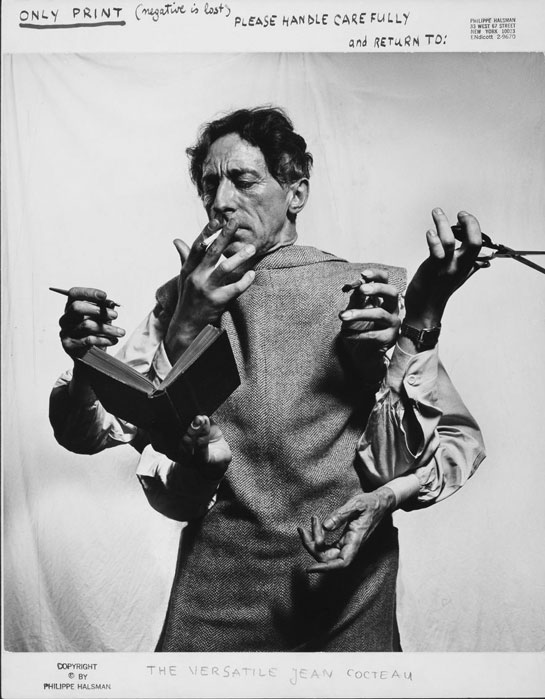
The Versatile Jean Cocteau, 1949.
In Paris, he began his portrait work, starting with André Gide; from there, figures such as André Malraux, Marc Chagall, and Le Corbusier passed before his lens. At the same time, he contributed to major magazines such as Vogue, Vu, and Harper’s Bazaar.
In 1940, he fled to the United States and settled in New York, where he combined his work in fashion and advertising for leading publications of the time with photographic series that allowed him to develop a more experimental dimension of his practice.
His photography is defined by a direct style, technical precision, and a meticulous attention to detail, but also by its diversity and constant experimentation with the medium. Halsman developed a rich visual culture, drawing inspiration from the techniques and aesthetics of movements such as New Vision in 1930s Paris. He also cultivated a powerful imaginative world influenced by Surrealism—an influence that his collaboration with Salvador Dalí enabled him to push to unexpected extremes.
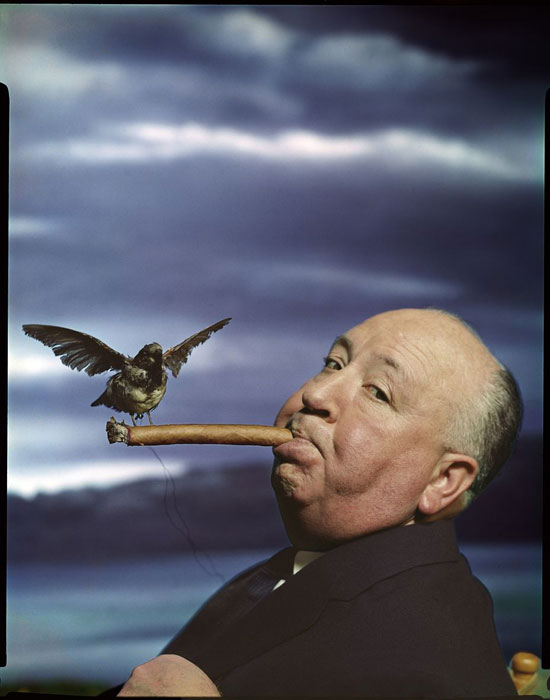
Alfred Hitchcock. Promotional portrait for the film The Birds.
In fact, as he himself acknowledged, he aspired to create the most surprising and original photographs—hence the title of the exhibition, Astonish Me. More than 500 pieces made up the show, produced by the Musée de l’Elysée with the support of the artist’s family: his most celebrated portraits, previously unseen material, photomontages, contact sheets, and print proofs, forming the most comprehensive retrospective of Halsman’s work to date.
No one has posted any comments yet. Be the first person!