
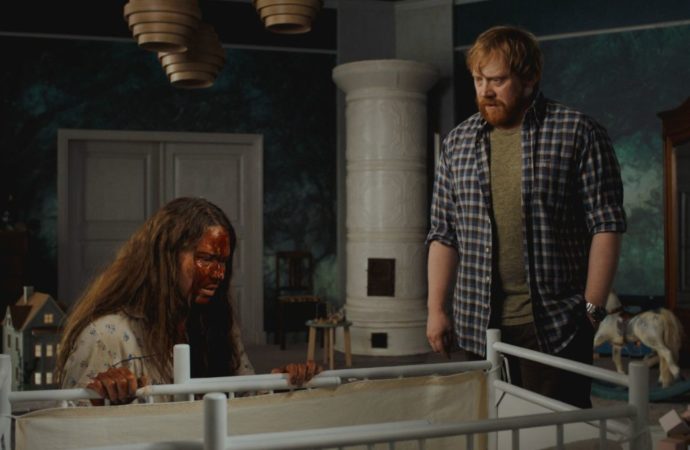

Nightborn, by Finnish director Hanna Bergholm, is an accomplished drama that blends horror with touches of humor and a message filtered through legend and the invocation of Nature—with all its telluric forces and implied determinism. This is not the first time the Berlin Film Festival has addressed the difficulties of recent motherhood, often resorting to fantasy or horror to amplify its message. It is Bergholm’s second horror feature following the success of Hatching, which won, among other accolades, the award for Best Special Effects at the Sitges Film Festival.
In her new film, the director magnifies the terrors of motherhood by confronting a first-time mother with an exhaustingly demanding baby, replacing hyperrealism with horror fantasy in the characterization of the infant—turning common maternal metaphors into literally frightening realities. The film incorporates supernatural elements, a personified environment (forest, trees, house), and a significant sociological dimension, exploring family dynamics, the couple’s relationship, and their wider social circle.
The inherited cabin, isolated and abandoned in the forest, which Saga (played by the outstanding Seidi Haarla, the protagonist of Compartment No. 6) and her British husband Jon (Rupert Grinch) reclaim for their new family, becomes the nest at the center of a disturbing story in which motherhood—far from being a placid river—turns into a torment to be negotiated, accepted, endured, or fought against.
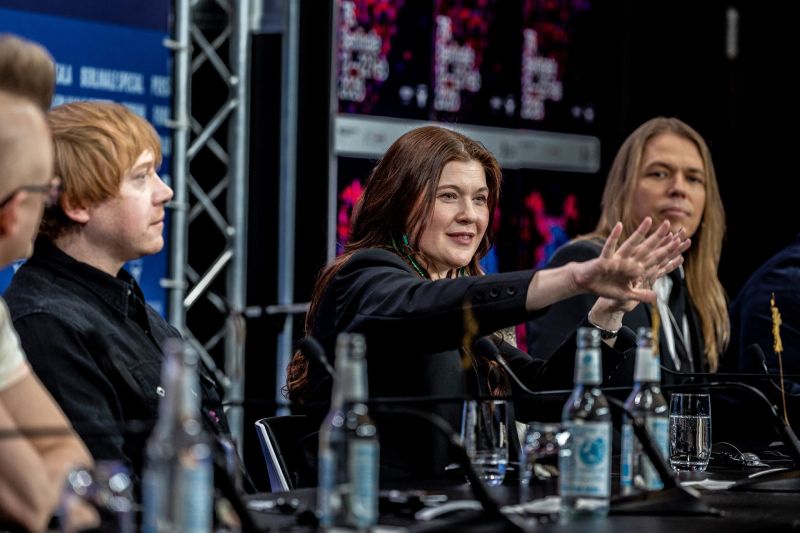
Rupert Grint, Hanna Bergholm and composer Eicca Toppinen in the 76ª Berlinale.
Bergholm and her co-screenwriter Ilja Rautsi gradually drag us down a slope of escalating challenges, where the surprises—free of gratuitous jump scares—each provide an essential layer of meaning in the development of both plot and thesis. The baby’s transformation, the grandmother’s revelations, and the father’s reaction paradoxically confirm that horror does not necessarily imply dysfunction.
An entire universe of insecurities opens up with motherhood, and Nightborn portrays it without shying away from each station of the via crucis, approaching it from a complex perspective. The director does not merely describe; she delves into the deeper dimensions of what she depicts. In doing so, she underscores the value of the chain of maternities within a single family and, more broadly, the expectations imposed by society, by the couple themselves, and by the remnants of patriarchal culture—without neglecting the allusion to the opposition between paganism (rooted in the natural environment) and religion (as imposed norm). The film ultimately suggests that giving birth and raising a child is not for the faint of heart.
What initially appears to be an unfortunate genetic mishap, in an unexpected outcome that Bergholm visualizes hyperbolically, unleashes an emotional state that moves from collapse to a negotiation with reality—with the child born of her own body and, dramatically, with the baby’s father. Nature demands its toll, yet it also offers a framework for understanding in a period where the natural insecurity before the unknown can be either soothed or exacerbated by one’s surroundings.
Nightborn turns metaphors into tangible realities and, through horror, affirms confidence in the bond that—save for exceptions—indissolubly unites mother and child. It does so with undeniable imagination and force, leaving no room for subtlety.

No one has posted any comments yet. Be the first person!