
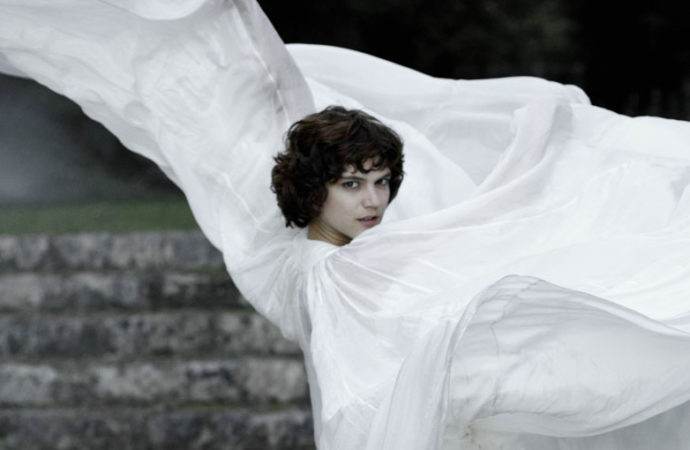
We imagined Loïe Fuller’s life as rich and complex. After six years immersed in the life and work of the winged dancer, director Stéphanie Di Giusto released La Danseuse, a film that delves into the artist’s titanic efforts to be herself and to push her art to unexplored limits.
Of Loïe Fuller we knew her avant-garde stagings—those in which, lifted more than two meters off the ground, she waved her arms wrapped in vast swathes of fabric. Serpentine dance, as her singular form came to be known, combined movement with unprecedented effects through the use of rods that supported the fabrics, lending the motion a hypnotic, vigorous quality. Accompanied by color-saturated light projections brought to the stage for the first time, dance and the avant-garde went hand in hand in early twentieth-century Paris.
Di Giusto set out to tell the life of this woman—strong and slight—played by Soko, from her native Illinois (1862), where her creative spirit was already emerging, unconstrained by the rural milieu of the Midwest, to her dazzling success in the capital of the avant-gardes, where she arrived (after a brief stay in London) and remained until her death in 1924. For the director, the film speaks of art as a means of escape.
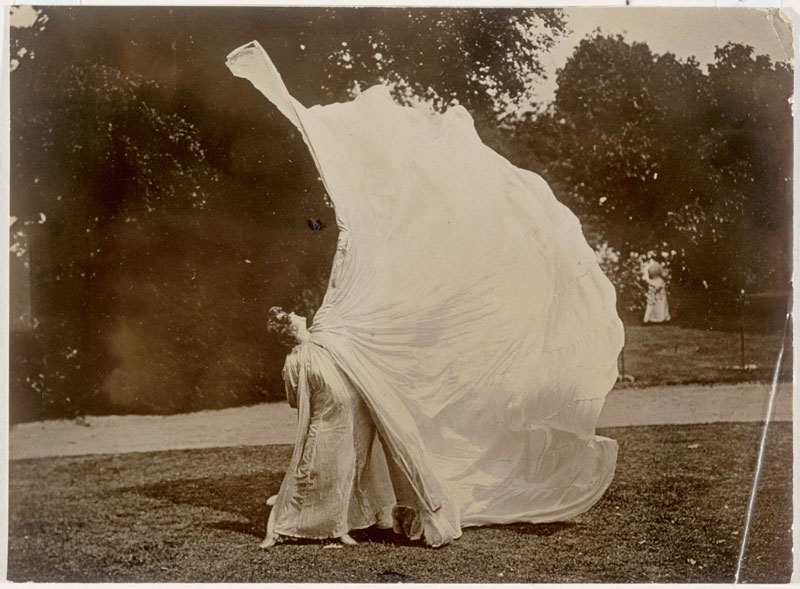
Loïe Fuller Dansant dans un parc, Harry C. Ellis.
A burlesque dancer in her early years, she performed at the Folies Bergère. A muse of the Belle Époque, a model for artists such as Henri de Toulouse-Lautrec, a friend of Marie Curie, admired by Auguste Rodin and other artists of the time who saw in her an unrepeatable magma, Loïe Fuller became, within a few years, a legend—and with it, one of the highest-paid artists of her era.
But there is no reward without effort—and in this case, without pain. The contraptions that made her pieces unique destroyed her back; far from being a simple visual play of arms and fabric, her dance involved total movement, gradually burdened by the weight of poles and thoroughly unergonomic mechanical devices.
Her eyes also suffered from experimentation with lights and projections, eventually causing serious vision problems which, rather than making her abandon her goals, pushed her to persist with tenacity. Each time she stepped onstage she fought a battle, the French director asserts, who also takes on the complex relationship she maintained with Isadora Duncan, the dancer of spontaneous gesture, portrayed by Lily-Rose Depp. While Duncan favored natural inspiration, fluid movement, and simple poses, Loïe Fuller fought, day after day, to perfect her complex stagings in order to astonish the spectator.
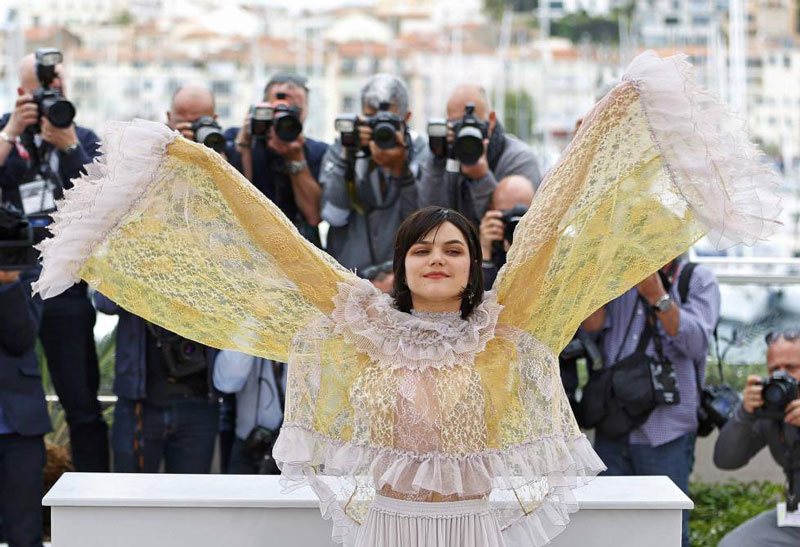
La Danseuse in Cannes
Di Giusto’s thesis is that Isadora Duncan’s arrival in Paris marked the beginning of the end for Fuller, as it stripped her of the stardom she had enjoyed until then by introducing new ways of dancing and of engaging with dance itself.
An entrepreneur, inventor, dancer, stage director—a pioneer of the performing arts—she repeatedly refused her friend Thomas Edison when he proposed to “put her in a box” by recording her dance. For this reason, one of the most complex tasks for Di Giusto was recreating the serpentine dance, since, as she explains, the images circulating online belong to imitators from Fuller’s own era.
La Danseuse premiered at the Cannes Film Festival in the Un Certain Regard section, dedicated to debut features that often receive very positive reviews; La Danseuse is an intelligent, well-documented work of impeccable craft, a wonderful journey for the spectator, stated Bénédicte Prot in Cineuropa.
The remains of Isadora Duncan and Loïe Fuller rest in separate graves in Paris’s Père Lachaise Cemetery, scarcely 100 meters apart. While the former’s grave appears polished and immaculate to visitors, the latter’s, covered in vegetation, is barely visible. The film seeks, through poetic justice, to recover the figure of an artist of whom little is known beyond the name of her serpentine dance.
No one has posted any comments yet. Be the first person!