
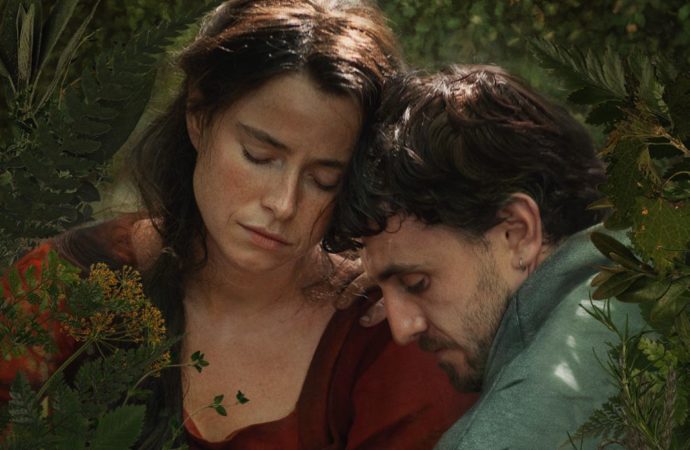

Hamnet, by Chloé Zhao, opens by showing Agnes, its female protagonist, curled up in a fetal position at the foot of a tree, immersed in nature. Beside her lies the entrance to a cave, representing the mystical void from which we come and to which we return, and about which we know nothing. It is a film marked by a powerful female gaze on the world, especially if one recalls the director’s statement that civilization is masculine, while nature is feminine.
An Imagined Story
Based on the novel of the same name by Maggie O’Farrell, the film reimagines the circumstances surrounding the creation of the most famous work by the most immortal writer in history, William Shakespeare: Hamlet. It does so by crafting its own story, regardless of whether it may be true or not. This is not a documentary about Shakespeare, but a new tragedy centered on one of humanity’s most ancient fears.
When we first encounter Shakespeare’s character, he is confined to a room, teaching Latin to a group of children. He then sees Agnes through the window, returning from the forest, and feels drawn to her as irresistibly as to nature itself. In this early part of the film, we witness Will and Agnes falling in love through expansive outdoor wide shots that at times make them appear like creatures of the forest—especially Agnes, so deeply rooted in nature that she goes into labor in the woods, in the very place where she was first introduced. During her second childbirth, however, a torrential downpour prevents her from returning there; nevertheless, water and nature still force their way into the birth of Hamnet and Judith, even as something suggests that not everything is right.
The two protagonists will eventually separate, but their bond will not be broken: he departs for civilization, while she remains in nature with their children. Paul Mescal confirms his status as the actor of the moment in his portrayal of the writer, but it is Jessie Buckley who ultimately commands the spotlight as Agnes.
When tragedy strikes their lives, each must confront it from their own perspective: she is skilled at living, a force of nature; he is skilled with words, though not as adept at navigating life as he is at transforming it and structuring it into fiction. Agnes’s primal response to that tragedy is one of the most painfully powerful performances of recent years. He, by contrast, is incapable of facing grief in real life, able to process it only through words.
The Cathartic Ending of Hamnet
And then the finale erupts—one of the most moving and cathartic endings in recent cinema. Zhao confronts the loss experienced by both parents without a single word spoken between them and ultimately turns to fiction as a balm, in all its carefully constructed splendor.
We enter the mythical Globe Theatre alongside Agnes; to some extent, we become the character of her brother, witnessing one of the earliest performances of Hamlet. From that moment on, Zhao not only places us before the most famous play of all time, but also floods the scene with Max Richter’s “On the Nature of Daylight,” a piece used in countless films and series, deployed here to provoke an emotional response in the audience that mirrors what the characters themselves are experiencing.
Another masterstroke is the decision to cast the real-life brother of the actor who played young Hamnet as the actor portraying Hamlet—bearing the same name, as we are warned at the beginning of the film. In this way, like Agnes, we see her son on stage, framed by that recreated forest and the same cosmic void.
Some may feel that the film betrays itself and its naturalistic essence in this ending, that Zhao resorts to every possible device to draw tears from the audience. Yet it seems clear that she understands that only art can represent the unrepresentable: the infinite pain of what we never wish to confront. Art cannot replace reality or fully heal us, but that catharsis can become the crutch we lean on in order to keep moving forward.


No one has posted any comments yet. Be the first person!