
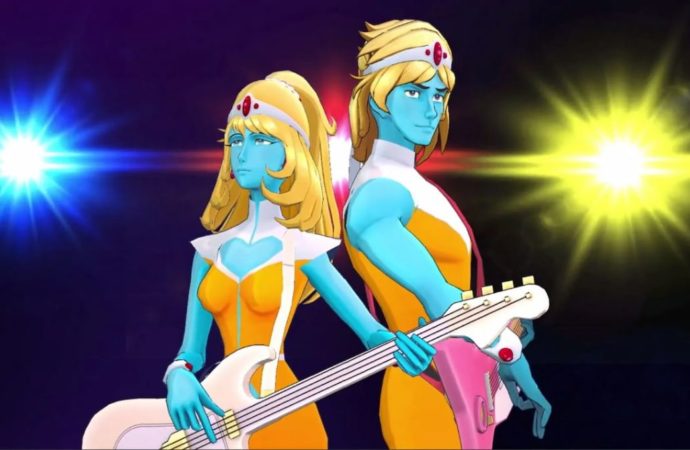

One could argue that Daft Punk’s Discovery is the most influential album of the 21st century alongside Radiohead’s Kid A. If the latter saw the most important rock band of its time abandon guitars and turn toward electronic music and other genres to avoid stagnation, Discovery, released shortly after, found the leading electronic act of the moment moving away from the house jams of Homework and embracing a sound open to rock, pop, and more classical song structures.
The artists themselves put it best: if Homework was a way of telling rock audiences that electronic music is “cool,” Discovery was their way of telling electronic fans, “you know what? Rock is cool too—you might like it.” Tracks such as “One More Time,” “Digital Love,” and “Harder, Better, Faster, Stronger” would go on to become guiding lights for 21st-century pop, and Daft Punk were among the first to turn Auto-Tune into a fully-fledged creative tool.
From this album emerges much of the sonic blueprint for pop music in this century: Kanye West would incorporate its aesthetics into hip hop, The Weeknd into R&B, and LCD Soundsystem into indie rock, not to mention its echoes in the evolution of The Strokes. Discovery is, quite simply, ground zero for 21st-century electronic music—informing artists from Justice to Disclosure, and beyond.
Origins
The origins of Discovery date back to 1998, when Thomas Bangalter teamed up with DJ Alan Braxe and vocalist Benjamin Diamond to create the seminal track “Music Sounds Better with You.” An irresistible song, it already contained two key clues pointing toward Daft Punk’s future.
First, there was a clear move toward a more structured, song-oriented format—closer to pop. Second, this shift was reflected visually in the music video, directed by Michel Gondry, in which the three members appear in matching outfits with painted faces that resemble robots—an early hint of the iconic aesthetic that would soon define Daft Punk.
Discovery was also the first album in which Daft Punk began using their now-iconic robot helmets, even claiming that at 9:09 on September 9, 1999, they suffered an accident in the studio and, upon regaining consciousness, had turned into robots. A stroke of genius that allowed them to conceal their identities for much of their career, surrounding themselves with an aura of mystery in an industry where personal image is almost as important as the music itself.
That said, by the time this “accident,” according to their own mythology, supposedly took place, they had already recorded what would become their most iconic track—the cornerstone on which Discovery was built. This was “One More Time,” recorded by Thomas Bangalter and Guy-Manuel de Homem-Christo in 1998. Remarkably, Daft Punk set aside the most important song of their career for two years while they worked on the rest of the album, a clear sign of their confidence in their vision.
When they finally felt the world was ready—and that they had a masterpiece to accompany it—they released the track on November 13, 2000, showcasing their extraordinary ingenuity. They transformed a sample from an obscure disco track—“More Spell on You” by Eddie Johns—into a kind of horn-like riff that drives the melody. Then comes the voice of Romanthony, one of their mentors, heavily processed with Auto-Tune, turning the track into the ultimate validation of a once-derided device. In their hands, Auto-Tune became a creative tool—akin to a wah pedal—embedding its sound firmly into the popular imagination.
A month earlier, the world had been shaken by its first encounter with Radiohead’s “Idioteque.” Now, “One More Time” confirmed that the 21st century would not sound like the 20th.
Daft Punk expands its palette
Discovery became the definitive confirmation of that shift. Daft Punk expanded their sonic palette, moving beyond the boundaries of electronic music and venturing into pop and rock territories, embracing more structured songwriting rather than focusing primarily on texture and production.
“Digital Love” featured an infectious melody, riffs, and even a synthesized guitar solo—which was not truly a solo, but rather a composite of sequencer effects—demonstrating their ability to reimagine traditional rock elements through electronic means.
In “Aerodynamic,” they also employed a kind of electronic solo, as if channeling a digital replica of Van Halen. Of course, rock was not the only influence on an album that also ventured into synth-pop, new wave, funk, disco, and even baroque pop territory. Take “Veridis Quo,” for instance, which sounds as though Brian Wilson had become an android in the year 2112.
That explains the added quality that defines this album: it is at once innovative and futuristic, yet also simple, emotional, and deeply nostalgic—a balance they would later push to its peak with their final work, Random Access Memories. By then, however, they no longer sounded quite as groundbreaking. What makes Discovery truly remarkable is that it anticipated the sound of pop music in the years to come, without ever losing its heart and soul.


No one has posted any comments yet. Be the first person!