


I admit that everything I dreamed was part of a private conversation
Two sides were negotiating across a single English-style circular table placed at the very center of a living room whose proportions dissolved into an immensity beyond comprehension—much like the language they spoke: an intermittent hum punctuated by pauses that were not silences and that, under any other circumstances, you and I would have taken lifetimes to process. But since dreaming transcends into a plane where everything seems to happen at once, where the simple becomes muddied, and the complex is simplified, we can agree that there may be dreams in which language schools are unnecessary.
Those same two negotiating sides were neither corporeal beings nor beams of light, just as the table around which they bargained was not really a table in the conventional sense. I resort to these concepts only because our minds require identifying labels in order not to lose themselves in abstractions that tend to resurface in other dreams. At some point in this one, the name Bowie emerged, right at the end of an extraordinarily long hum, and as if a hidden switch had been pressed, I became aware of where I was sleeping.
On the sofa of the house I thought I had left behind long ago, and to which I always returned whenever problems resurfaced.
At first, David Bowie appeared to me as a blur, or a sigh in time that, as if that were not enough, proved difficult to approach. Only through effort did flashes arrive first, then images: a beautifully tailored suit, a carrot-colored quiff, a voice whose vibrato unraveled into a velvet one could almost touch. The voice… the voice seemed to illuminate everything, like a flashlight tracing the dark corners of an abandoned storage room in the middle of the cosmos. Yes, for years—nearly fifty—Bowie had been an unclassifiable event in the lives of many, a bolt of light wrapped in the cellophane of a particularly media-savvy rock star. His ever-changing image, ambivalent, sexually ambiguous; his retinue of acquaintances among whom he loomed as a respectable guru; his peculiar codes of conduct; his magnetism embodied in a style always running counter to demand rather than expectation—that finger poked into the eye of everyday continuity—had long attracted a crowd that never stopped adoring him, even in the worst of times. Even his sudden death was interpreted as a “final trick,” yet another way of making an impact, of catching destiny off guard. For months, after the catharsis, the planet kept spinning on its inertia, as if waiting for a single that would prelude an album that would prelude a new character—one that, in this case, might have challenged the other world. Ten years later, as recently as yesterday, there were still those who continued to await a resurrection.
Here the chronicle of the rock star came to an end
It was a few weeks after that anticlimactic January 10, 2016, when someone began hastily declassifying a series of reports based on thousands of pieces of evidence cross-checked by investigative agencies (and verified by a couple of space agencies). From these materials, a Taiwanese-born director assembled the documentary Changeling, which allowed the world to shift its perspective not only on Bowie, but on the universe as a whole.
David Robert Jones had not first seen the light in Brixton, but near the pyramids of Elysio, a well-mapped landscape on the Martian plain. It was impossible to verify his age without a significant margin of error, since the clues pointed to events that had taken place on Mars rather than on Earth, and were therefore unknown to us. What is known is that he had visited us twice before, driven by an insatiable curiosity and an unknown technology. The first time was in the era of Giotto, from whom he absorbed—briefly, as a disciple—a technique that appeared only in his finest work, the sole one he never published; a technique that, being expressible only in a single, definitive attempt, he ultimately discarded. The second visit found him serving as a Venetian ambassador at the decadent court of the child Louis XV, where he discovered the meaning of irony and experienced excessive luxury and the sonic wall of an entire new range of wind instruments. Both visits were brief—just a few months of exploration.
For the third, he planned a different experiment. He wanted to integrate into a complete life and experience it fully. He longed to be everything at once—something usually possible only in dreams—but he also possessed the instinct to understand that the experience would be richer and more exhilarating if begun from a lower floor and ascended gradually, and if he chose an artistic discipline capable of awakening empathy and affection in others—both of which he required as vital fuel far more than the respect or terror he might have commanded as a military leader, or the superficial condescension he would have faced had he chosen the path of the gray artisan. He therefore discarded Giotto, intuiting that as a visual artist the media elevator would move more slowly. Instead, he chose London in the mid-twentieth century, in the aftermath of war, which he perceived as an ideal breeding ground.
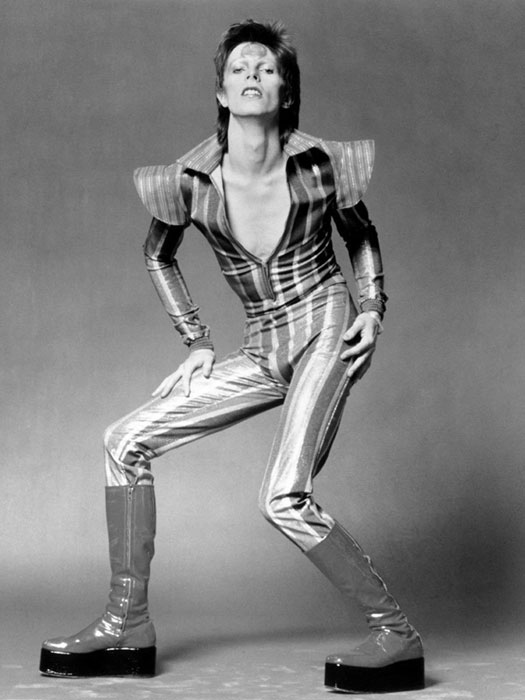
This Bowie knew how to navigate his new habitat brilliantly
He discovered the acoustic guitar and poured into it his readings and swagger, behaving like a young Dylan with the bearing of a dandy—at least until the 1960s collapsed, and psychedelia sent him down different paths. He became increasingly multidisciplinary as music and the apparatus of his time grew simpler. His playful streak pushed him to leave clues here and there of his true nature, while he constructed around himself a series of alter egos that alternately drew him closer to and pushed him away from the new world he was helping to found.
He took a risk by creating a genuine Martian: Ziggy Stardust—wrapped in leather and latex, crowned in a shrill red that emitted vibrations detectable miles from the stage (measurements that raised many questions and put restless minds on the right trail). At the height of success, he decided to kill him mid-performance using a certain invisible Martian technique, to give life to Aladdin Sane, the one with the lightning bolt slashing his face—another androgynous specimen sprung from the entrails of Kabuki Theatre. He, in turn, was abandoned for a pale, lanky, elegant figure known as the Thin White Duke, and he in turn…
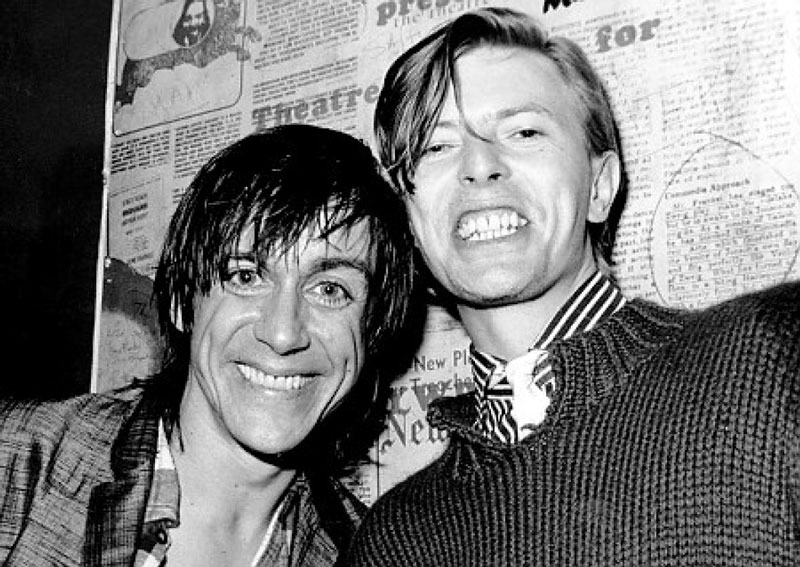
These accelerated transitions were stitched together with Martian friends (Iggy and Lou, themselves from the shores of the Mariner Valley), family skirmishes, and rivers of cocaine consumed as if they were part of a revolutionary diet—producing no effect on his alien physiology beyond progressive weight loss. The alter egos, however, revealed something Bowie had not known: the nitrogen levels of Earth’s atmosphere, combined with a new pollution courtesy of the 1970s, were becoming intolerable for his immune system. The transformations that renewed his being were therefore necessary insofar as they bought time and postponed cellular degradation. This definitive explanation for his constant mutability led him to abandon the Thin White Duke in favor of a regenerated pop star—from the dark gray of West Berlin to the papaya hues of Californian sunsets; from there to a rocker-crooner with a full band; then to an aging glory performing with the tics of aging glory (even this was prepared); to a resurrected, alternative artist in search of creativity and credibility along the techno path; to an elegant pop master; and finally to a hidden enigma.
Between 2004 and 2016, he played at disappearing, placing new works on the market only when he was presumed gone, to witness the glow of sincere—and not so sincere—praise from an industry and a critical establishment that devoured everything except loose verses. I said earlier that it was hard to convince people of his death. Only when the deterioration became too evident—69 Earth years lived at a speed of 240—did he decide to return to his red Martian desert. He left behind a testament called Blackstar: magnetic, lugubrious, and commercial—simply to prove to the world that leaving at one’s peak leaves a more lasting memory.
But we had been speaking for some time now about a dream in which I was merely a spectator, watching entities negotiate a series of points while simultaneously speaking of Bowie. It took me a while to understand that both notions were inseparable, and that Bowie himself set the terms of the negotiation insofar as he was the commodity being discussed. It was just as difficult to accept that it was not only in the lyrics scattered over the years (“Starman,” “Space Oddity,” “Loving the Alien,” “Gemini Spacecraft,” “Blackstar”), but above all in the music itself—whether an off-beat bass line, ten seconds of funky guitar, the electric flash that precedes the opening of pieces like “Ziggy Stardust,” the synthesizer bouncing from one speaker to the other in many techno moments of the 1990s, or the very inverted saxophone phrase with which he exasperated the orthodox listener—that I had any real chance of deciphering that curious amalgam of hums, and through them, of knowing and understanding the entity David Bowie.
The decoding of data hidden in music never went beyond a preschool level on Earth, whereas in that boundless hall, it functioned as a remarkably efficient interface. Through it, I began to uncover everything I have been recounting here, and something more besides: that the Martian who visited Earth as an experiment and left it out of necessity was nothing more than yet another disguise—perhaps the only one not designed by himself.
Both entities seemed to represent the interests of two different planes of existence—what we would clumsily and reductively explain, for the benefit of laypeople in 2016 or 2026, as parallel universes. The entity positioned to my left, from where I stood, was the negotiator corresponding to my/our “universe,” and he was clearly at a disadvantage. Bowie was a source of energy so scarce and powerful (though not the only one) that it could not belong to a single place alone. It had to be shared.
Over the course of sixty-nine Earth years, he had, in one way or another, enriched our planet, as no insignificant portion of its inhabitants could attest. Their vital soundtrack had been struck by a meteor that made them feel, choose, change, remember, or simply become better. A kind of mental can opener, perhaps. A supernova that, by blinding us, allowed us—just a second earlier—to see everything.
Now it was the turn of others to live within his same space, to perceive his presence for the first time. To experience it.
And I remember, upon waking from this strange dream about a bilateral alien negotiation, the sensation of a pasty mouth against the scratched background of a record-player needle that had long since surpassed the limits of its vinyl. The sound was insidious yet at the same time soothing, and it occurred to me then to imagine another device acting as a player—designed in a way that would be especially incomprehensible to us—from which would emerge the first notes that our ears could never decipher, but those of an adolescent protoplasm could: listening, feeling, living for the first time the accumulation of sensations that, with time (if time there was something measurable), would lead them to acquire what we could only understand as tickets to the first tour David Bowie offered to his new converts from another universe.




No one has posted any comments yet. Be the first person!