


Summer Wine,” by Nancy Sinatra and Lee Hazlewood, is a romantic thriller turned into song that embedded itself —with notable results— within another thriller: Stoker, by Park Chan-wook.
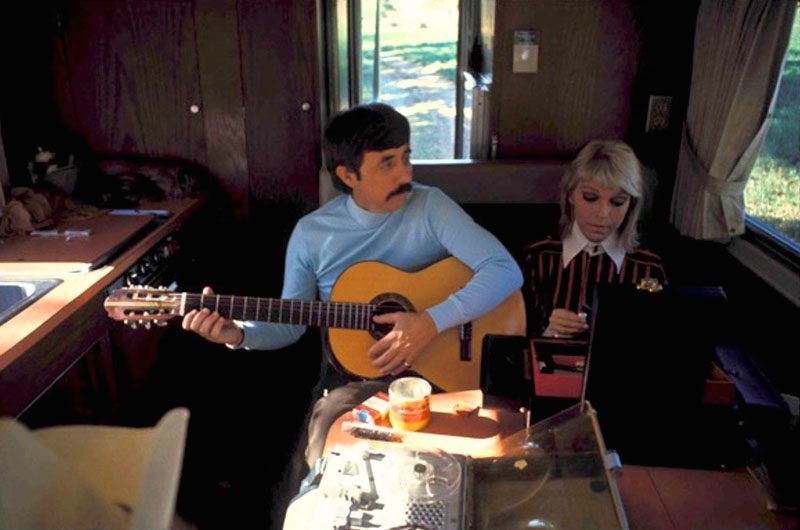
Legend has it that Lee Hazlewood, in his role as libertine producer, ill-intentioned demiurge, and shadow genius making all the decisions, advised Nancy Sinatra to sing the lyrics of “These Boots Are Made for Walkin’” as if she were a fifteen-year-old girl walking into a truckers’ bar. In other words, that her performance should aim straight at the crotch of men whose brains are located right there.
The sexual voltage, then, of the most illustrious songs by this duo (in many cases the American counterpart to the lubricious duets of Serge Gainsbourg) is one explanation for the greatness of their repertoire. It is not the only one: there is also something of outlaw romance, of you and me against the world, baby, and of dangerous—perhaps forbidden—beauty. In the fatalistic western of “Bang Bang”, the song Quentin Tarantino chose to open Kill Bill; in the arabesques of “Some Velvet Morning” that drove later decades of indie artists wild (notable versions by Lydia Lunch and Rowland S. Howard, by Primal Scream or Goldfrapp and John Grant, and an undeniable influence on the somnambulant rock of Mazzy Star, for example); and in “Summer Wine”, a murky tale to the greater glory of femmes fatales, all of these attributes can be clearly appreciated.
In Stoker, Korean director Park Chan-wook’s debut in the United States, the song “Summer Wine” punctuates the narrative as if its use within the story were a strategy of predestination, foreshadowing the characters’ fatal destiny. The stylization of innocence and the suggestion of the characters’ dark motivations are, in fact, more evident in the sinister meanders of this beautiful 1967 song than in the plot twists of images that may be excessively aestheticized.




No one has posted any comments yet. Be the first person!