
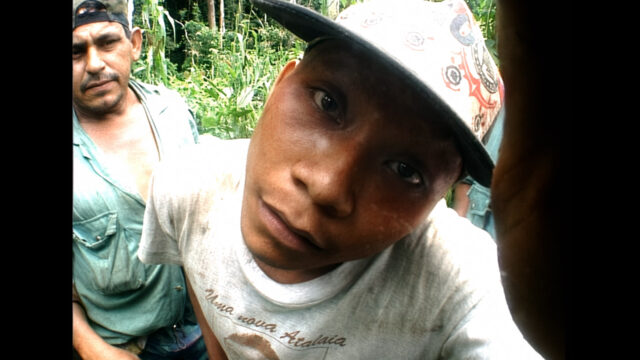

FIPRESCI winner at CPH: DOX, Amazomania (Nathan Grossman, 2026), offers a striking and thought-provoking perspective on the collision between modern society and indigenous life. More than a record of cultural encounter, the film interrogates the ethics of filmmaking itself, exposing the fragile illusion of human connection and the corrosive force of capitalism.
The narrative follows Swedish filmmaker Erling Söderström into the depths of the Amazon, unfolding as a carefully layered structure across multiple timeframes. Grossman constructs the film in three distinct movements, gradually reshaping the viewer’s understanding—and, at times, confusion—of what is seen.
It begins with archival footage from Söderström’s expedition to the Amazon, where he documented a first encounter with the Korubo tribe. At the time, the mission aimed to establish peaceful contact and define territorial boundaries following violent clashes between the Korubo and outsiders. The risks were immediate and real: the expedition members knew they could be attacked before any communication was possible. As the group moves deeper into the jungle, the film immerses us in extraordinary footage of a fragile and dangerous environment, culminating in the first contact—an encounter as tense as it is historic.
Amazomania interrogates the ethics of filmmaking itself, exposing the fragile illusion of human connection and the corrosive force of capitalism.
These images, preserved by Söderström for decades, carry a powerful emotional charge. They document a moment of irreversible transformation: two worlds meeting, observing, and misunderstanding one another simultaneously. We learn everything about them, and they—about us, he reflects. While the visitors film relentlessly—later revealed to have been perceived as a form of threat—the Korubo respond with their own rituals, offering substances intended to calm or even poison outsiders. Even in this apparent moment of connection, unease persists: the expedition leader warns that violence often follows initial contact. Yet the group leaves with a sense of revelation. Söderström himself expresses a hopeful wish: that the Korubo might continue to live freely, and in peace.
Following his return, Söderström produced a film from this material, earning recognition at festivals. Decades later, he returns to the Amazon—this time as the central figure in Grossman’s documentary.
What begins with almost childlike anticipation quickly turns into a confrontation with reality. Söderström revisits what he once considered an untouched “Eden,” recalling individuals by name and describing the Korubo as the last free people on Earth. Yet the world he encounters has changed irrevocably. The Korubo now use solar panels, express interest in technologies like Starlink, and engage with money as a central value. They challenge Söderström directly—questioning the use of their images, demanding compensation, and, at times, openly threatening him.
The transformation is disorienting, not only for Söderström but for the viewer. The idealised vision of untouched purity collapses, replaced by a far more complex and uncomfortable reality. What emerges is not simply a story of cultural loss, but one of entanglement—of systems of value imposed, absorbed, and contested. As so often, capital fractures smaller communities from within, redirecting attention away from larger structural forces toward internal conflict.
What happens when every form of human relation is gradually translated into transaction?
The film does not offer resolution. The tensions between Söderström and the Korubo remain unresolved. The closing notes reveal further expansion of digital infrastructure into the region, continued exposure to disease, and a fragile population reduced to approximately 150 individuals—a number that speaks directly of an uncertain future. Despite stating, in a moment of despair, that he wanted nothing to do with Grossman’s film, Söderström was present at the premiere and is already planning to return to make yet another film about the Korubo.
Amazomania stands out as a vital work within contemporary anthropological cinema. Beyond its rare ethnographic value, it is ultimately a film about the devastating impact of capitalism—how it infiltrates, reshapes, and fractures even the most isolated communities. What begins as an encounter between cultures reveals itself, over time, as an unequal absorption into a global system that commodifies images, land, and identity alike. The ethical dilemma is therefore not limited to the act of filming by “privileged” Western filmmaker, but extends to a broader question: what happens when every form of human relation is gradually translated into transaction.
What unfolds is a process of mutual disillusionment—as painful as it is necessary.




No one has posted any comments yet. Be the first person!