
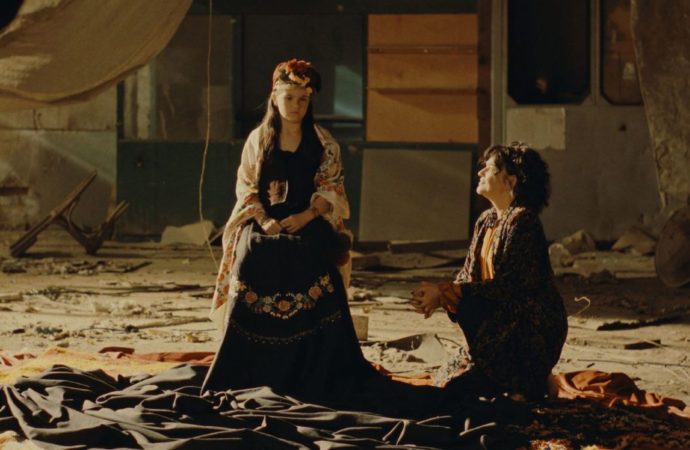

Director Geneviève Dulude-De Celles recounts in her second feature, Nina Roza (Fleur bleue, 2026), a story of exile, self-hatred, longing, and genuine artistic inspiration. The film stars Mihail (Galin Stoev), an art expert based in Montreal and born in Bulgaria, who is tasked with authenticating the work of a child prodigy whose paintings have gone viral on social media and are exclusively marketed by an Italian art dealer.
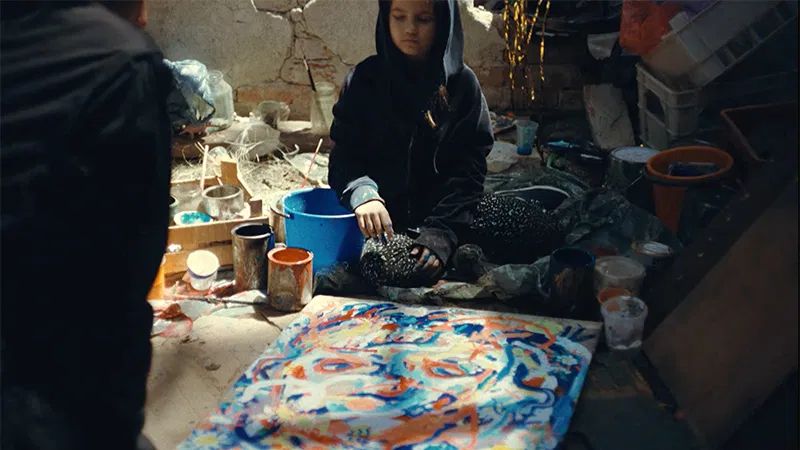
Deeply reluctant about the assignment, Mihail—a curator and advisor to collectors—returns to Bulgaria, the country he left in the 1990s after the death of his wife. As Dulude-De Celles portrays in the sequences preceding his departure, Mihail rejects everything that reminds him of his homeland, symbolized by his refusal to speak or teach Bulgarian to his own grandson. However, his encounter with Nina (played by nine-year-old twins Sofia and Ekaterina Stanina) compels him to reassess his perspective. The girl is remarkably mature; her arguments are naive yet lucid, prompting Mihail to reconsider his role in the art world, as well as his attitude toward his country and his past.
The parallels between Nina and Roza (Michelle Tzontchev), his own daughter, bring long-buried memories to the surface—memories he must now confront in order to settle unresolved accounts with a past that has fueled conflict between father and daughter. Mihail faces the ghosts of his former life, realizing that one cannot simply turn the page without making peace with the most painful memories and the death of a loved one. His visceral rejection of everything that takes him back to his homeland—reflecting a love-hate relationship with one’s own culture, with what we come to despise and leave behind when settling in a more developed country—is also scrutinized in Nina Roza.
The dialogues between Mihail and young Nina disarm him through her frankness and spontaneity. The task at hand proves to be not only the authentication of the artwork, but of his own experience and the meaning of his professional authority. Beyond the intrigue surrounding the authorship of the paintings—narrated with assurance and restraint—lies an intimate journey, an exploration of the significance of roots in order to find one’s place in life. Through conversations in which Nina opens herself to a stranger she believes capable of understanding her—beyond the interests of her mother and the art dealer—Mihail is led to question by what right success, money, and a secure future can compensate for the disruptive risk to one’s identity that exile entails.
The questioning of the value and power of art is also central to Nina Roza: its pleasure, its utility, and the mercantilism that surrounds it. The refusal to paint if it entails a financially secure yet displaced and disoriented life—where passion becomes a sentence rather than a calling—stands as a declaration of principles.
Geneviève Dulude-De Celles, who won the Crystal Bear seven years ago with her debut A Colony in the Generation Kplus section, portrays with respect and cinematic beauty the relationship between past and present. The flashbacks are both symbolic and tangible, enhanced by the accomplished cinematography of Alexandre Nour Desjardins, particularly in the Bulgarian landscapes that eloquently illustrate silence. Mihail’s catharsis is moving and realistic, as complex as the characters themselves, who resist easy archetypes. Nina Roza is an outstanding film that needs neither heavy-handed emphasis nor formal snobbery to persuade and captivate.


Nadie ha publicado ningún comentario aún. ¡Se tú la primera persona!