
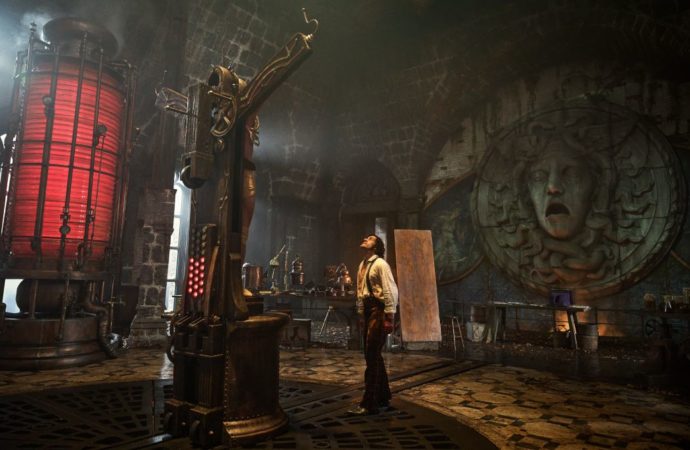

Providence would have it that Guillermo del Toro premiered his Frankenstein at the 82nd Venice Film Festival on the same day as Mary Shelley‘s birthday. It is a lifelong project that the director has been nurturing since he saw James Whale’s Frankenstein at the age of seven. And, as he joked during the press conference, after bringing his creature into the world, he is now in the throes of ‘postpartum depression’. After all, a film is also a kind of creature of Dr. Frankenstein, fragments of images of what once existed, assembled in such a way as to simulate organic coherence, and animated by a movement that gives us the illusion that these fragments are alive. Guillermo del Toro says that everything he has been doing since his first film, Cronos, and all his learning, as well as his ideas about directing, were destined to be applied to this work. Fast-paced, metaphysical, delicate, colossal. The film, competing in the official section for the Golden Lion, an award he won in 2017 with The Shape of Water, will premiere on Netflix on November 7.

Jacob Elordi as the creature in Frankenstein. Cr. Ken Woroner/Netflix © 2025.
Guillermo del Toro’s love of Gothic horror and monster stories, that poetics of horror, achieves an irresistible and absorbing aesthetic force. Each setting, device, or lighting effect is a precious element that transports us to the lights and shadows of the 19th century, when Dr. Victor Frankenstein’s defiant ambition drives him to delirium. The experiments carried out on human bodies leave us with several unforgettable icons of technological and refined body horror throughout the film. Despite all the film versions of the novel, the material reconstruction of the monster had rarely been staged, and here the director revels in a cheerful scene of casting, dismemberment, and carnal excess that, rather than horrifying, shows the doctor’s enthusiasm for his work like a child putting together a puzzle. Most of the sets and their content have been constructed, not computer-generated. Guillermo del Toro states that he only uses digital effects when the limits of the physical do not allow him to find a solution to get where he wants to go. He believes that the result of the actors’ work is very different when they look at a green screen or a real space.

Guillermo del Toro and Oscar Isaac, during the shooting of Frankenstein.
Oscar Isaac as Victor Frankenstein, Mia Goth as his sister-in-law and beloved Elizabeth, Christoph Waltz as his mentor, and Jacob Elordi as the creature, wonderfully embody the script that del Toro himself adapted. Victor, in his youth, egocentric, excessive, and irresponsible, meets a sharp and incisive Elizabeth who leaves no room to indulge the scientist’s ruthless fanaticism. The monster is a newcomer to this cruel world who symbolizes purity, with one foot in the horror of anatomical reconstruction and the other in the refinement of alabaster sculptures. It is an aesthetic representation of supernatural beings that Guillermo del Toro has repeatedly formulated throughout his career.

The film is structured in three parts, beginning with an intermittent prelude that runs through both the first chapter, which tells the “story of Dr. Frankenstein,” and the subsequent “story of the creature,” finally merging with the dénouement. In this way, it first focuses on Victor Frankenstein’s point of view and then on that of the monster, which has popularly acquired the name of its creator in a confusing speculative game, but which in reality was never given a name of its own.
The question that underlies the novel and which Guillermo del Toro recovers from the heart of his film is: What does it mean to be human? Where does the soul reside? When the spark of life ignites the dead flesh that makes up the monster, Dr. Frankenstein sees in it little more than a moving corpse, perhaps something akin to an animal. Now, this product of experimentation has no choice but to live out its moribund life forever. From this gap between the heartless creator and the innocent creature, which most deny the status of humanity, arise the introspections embraced by the film. And at the core of the tragedy, the capacity for forgiveness seems the most human thing that can happen to these fractured characters. In the words of the director: We have no more urgent task than to remain human; we must understand each other even under the most oppressive circumstances.


Nadie ha publicado ningún comentario aún. ¡Se tú la primera persona!